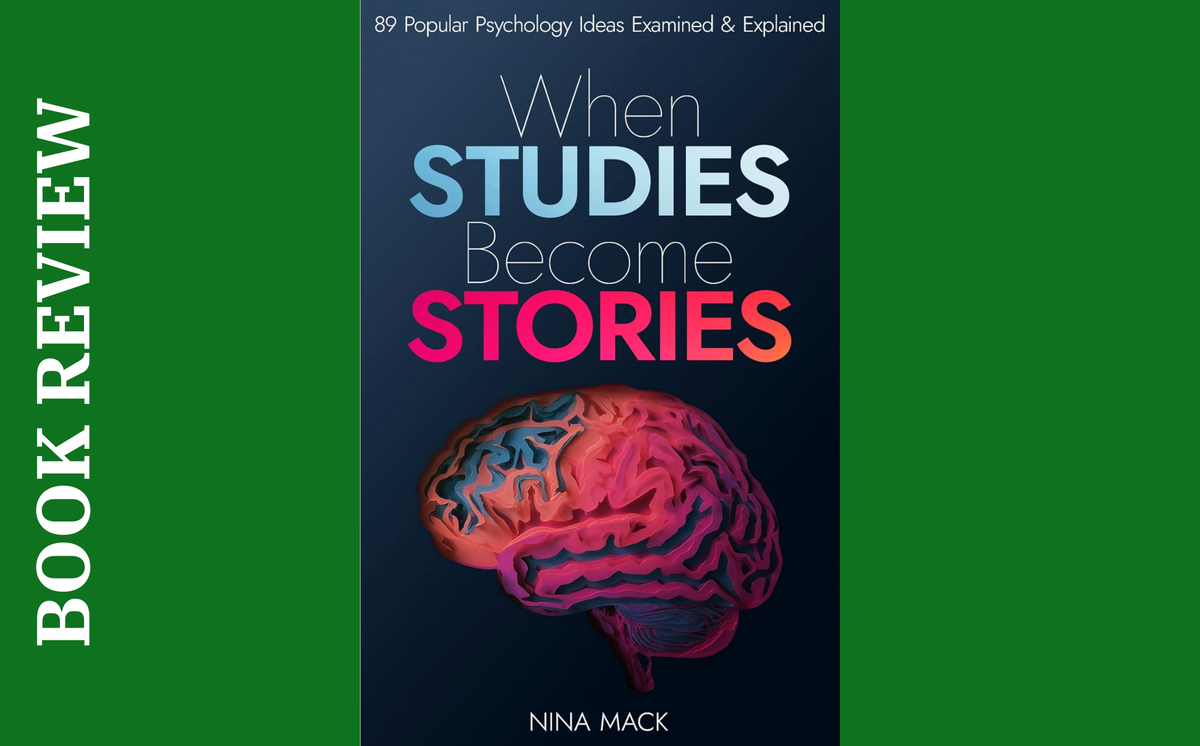
When Studies Become Stories: 89 Popular Psychology Ideas Examined & Explained by Nina Mack

Hi! I read a ton of books and am getting back into critical writing after a long break. I'm going to play around with my writing style and am also figuring out my audience. I welcome helpful feedback.
I'm a big fan of self-help and popular psychology books. I also have training as a scientist and journalist, which is why I bring a degree of skepticism to the claims made in books of these genres. Nina Mack’s first book offers an overview of many of the most widely known claims from the field of psychology, summarizing their meaning, typical use, and explaining whether and how much they are grounded in scientific research.
In doing so, Mack has created a neat primer for readers who want to better understand how to evaluate scientific claims discussed in mainstream media. She briefly explains each of her 89 selected concepts, including where a reader may encounter them in books or interactions with others. Each concept is assigned a “verdict” by Mack: has evidence, overstated, oversimplified, and no evidence, giving the reader an understanding of the scientific grounding of each concept, or lack thereof. A preface explains these verdicts in detail, and briefly defines several scientific concepts used to explain the verdicts, including replication, sample size, and statistical significance.
The book groups psychology concepts into four sections: the self, social life, choice, and society; each major group is further organized into narrower groups, like judgement, memory, and learning within the self section. At the beginning of each, these sections are briefly outlined with descriptions of their sub-groups, enabling a reader to quickly jump to a section of particular interest.
Most surprising to me was encountering concepts I erroneously believed were grounded in scientific evidence, like learning styles, and the idea that a person can be left- or right-brained. The biggest challenge I encountered was that the book’s design is extremely plain - the entire book is text, with a few heading sizes, and this made the content feel more boring than it is. I also struggled with the “How to Use it” sections. Mack seems to intend this section to tell the reader how they can use the concept accurately (or in the case of those with no evidence, which concepts to apply instead). These sections were the least uniform, and could have been edited to offer more consistent and carefully described options for the reader.
Ultimately, When Studies Become Stories is a useful reference for people who lack scientific training, are interested in psychology, and want to develop a more critical approach to reading about psychological concepts in mainstream publications and daily interactions.